
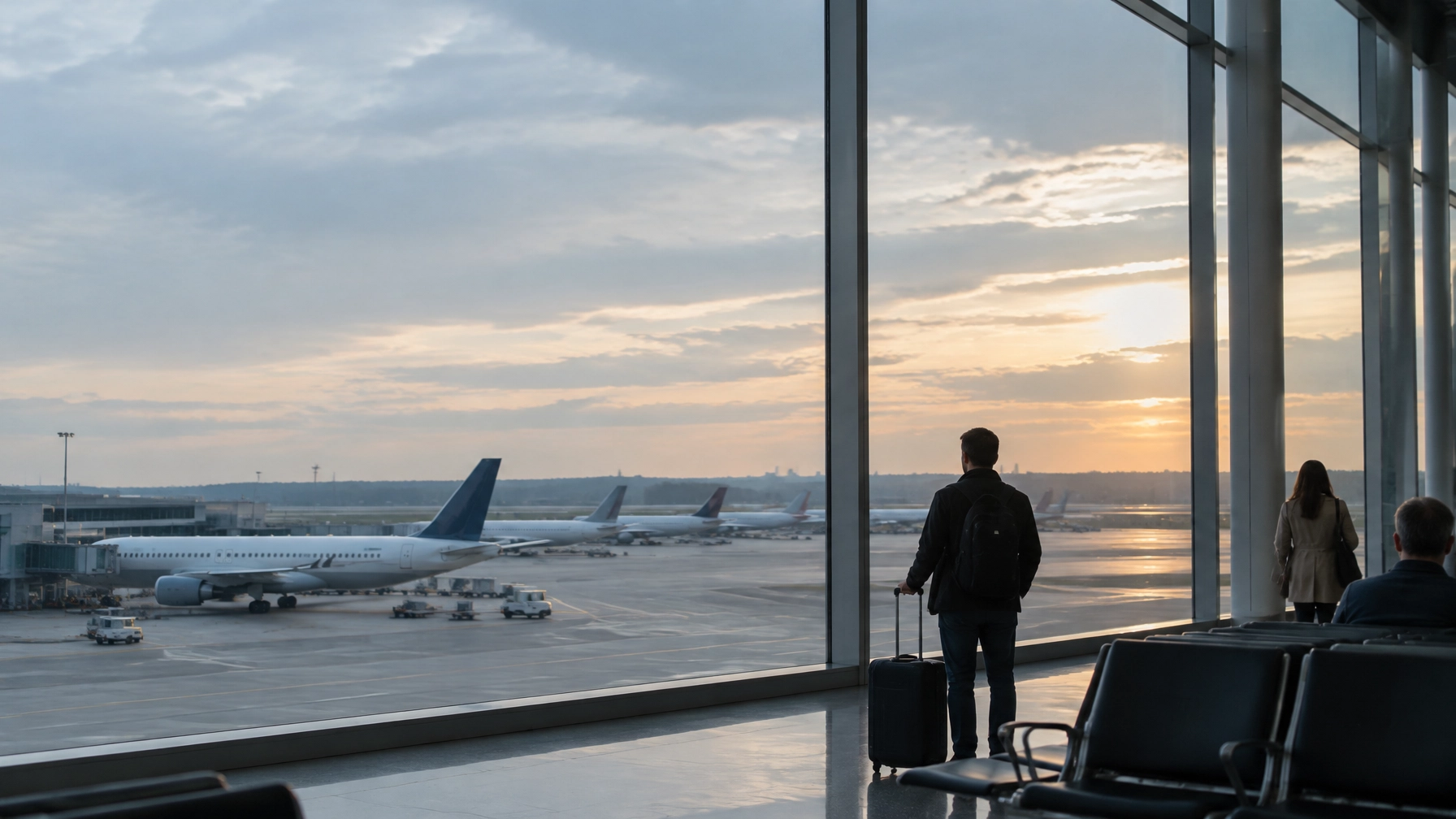
At 2:54 p.m. Central time on Friday, November 13, every departing flight in the United States was stopped. Airport gates filled. Departure boards changed. People waiting to travel had little choice but to wait.
The FAA made the decision after communication problems disrupted air traffic control centers. This was only the second nationwide ground stop since September 11, 2001. The other was in January 2023.
The stop lasted just over four hours. By then, nearly 5,000 flights had been canceled and more than 10,000 delayed. Disruption spread beyond the United States, as Europe and Canada held flights bound for the country and air cargo backed up.
The incident is a reminder for business owners: a major outage does not have to involve a hacker or broken hardware. Sometimes the trouble starts in a system that has grown over time, with connections and dependencies no one deliberately planned as a whole.
What happened, in plain English
Air traffic controllers rely on communications networks to talk with pilots and coordinate the handoff of aircraft between control centers. On Friday, a failure disrupted communications across all 22 regional air traffic control centers. Controllers lost radio frequencies and the automation used to hand off flights. Chicago went dark first.
Transportation Secretary Sean Duffy said the official explanation involved an “inconsistency” in data from network routers on what he described as an “incredibly old air traffic system.” Reporting from CBS News and The Wall Street Journal pointed to an update on the L3Harris operated network. According to that reporting, the system crashed when it rebooted.
That account is not a final finding. A full post incident report is still pending. The FAA’s preliminary statement said communication issues were affecting multiple air traffic control centers and that technicians were investigating.
The broader context matters. The FAA is in the middle of replacing a decades old copper network, and a new prime contractor took over this summer. In September 2026, a smaller outage happened when a primary circuit failed and the backup fiber had already been cut. That does not establish the cause of Friday’s outage, but it shows why the connections between systems and the state of their backups deserve close attention.

What it was not
DHS and the FBI said there was no evidence the outage was caused by a cyberattack. DHS also said it was not connected to the Microsoft 365 outage from the day before, which lasted about 24 hours. The vendor behind the FAA’s new SMART AI tool said that system was not involved.
Those distinctions matter. A business that treats every technology disruption as a security incident may miss other important risks: an aging network, a failed change, a backup that is not ready, or systems that depend on the same connection.
IT security remains essential. But security is only one part of keeping a business operating. A strong plan also accounts for routine changes, vendors, infrastructure, and what employees should do when a service they rely on stops working.
The real lesson is systems planning
Technology is more than a collection of devices and subscriptions. It is the way a business operates, and the connections that let people, applications, and vendors work together.
When those connections are understood and planned, a business can make a change with a clearer view of what else might be affected. It can know which services rely on the same network, how to restore work, and who is responsible for helping. When that planning is missing, one update or one failed connection can have a wider impact than expected.
The practical goal is not to promise that nothing will ever fail. It is to understand what depends on what, reduce avoidable points of failure, and decide in advance how the business will respond. That is the foundation of business continuity, whether the organization is an airline or a small business with a handful of critical applications.
Five questions every business owner should ask this week
-
Find your single points of failure. Voice, data and automation all rode the same network. What do your phone system, internet and line of business app share?
-
Prove your backups. A backup nobody has tested is a hope, not a plan. Do you know what can be restored, how long it will take, and whether the restored information is usable?
-
Watch the in between. The riskiest time is mid migration, when old and new systems run side by side. Do you know which processes depend on each one, and what happens if a transition takes longer than planned?
-
Know your vendors. When the FAA needed answers it depended on contractors. Do you know who to call, and do they answer? Is it clear who owns a problem that crosses multiple providers?
-
Decide in advance what you will do when a vendor you rely on has a bad day. Which work can continue? Who tells employees what is happening? What is the fallback for customer communication and essential operations?

A steadier approach to IT
For a small business, a systems review does not need to start with a major project. It can start with a clear picture of the services employees rely on, the connections between them, and the steps needed to keep work moving during an outage.
Next Legacy IT helps organizations build that picture through strategic IT guidance and vCIO style planning, change management, vendor coordination, network support, redundancy, and business continuity planning. Our IT services are designed to help businesses move beyond reactive IT support and make technology more reliable, secure, and aligned with their goals.
The FAA incident is still being investigated. But the questions it raises are useful right now for any organization that depends on technology to serve customers, support employees, or keep operations moving.
Book a free systems planning conversation with Next Legacy IT, and we will map where your business has a single point of failure before it finds you. If you would rather talk it through first, ask for a 15 minute call.
Email hello@nextlegacy.it, call 219 786 3676, or book your planning conversation.
